Reboot
Reboot is a marketplace that redistributes retired data centre hardware to reduce e-waste and make high-performance computing accessible. Hardware is sorted by what you can build with it, every part shows where it came from, and a project builder takes you from parts to a working build.
- Role
- Product manager and designer
- Team
- Jenny Yang, Kelly M, Lucas Vu
- Timeline
- UofT UDesignathon, February 2026
- Scope
- Survey research, product strategy, product design in Figma
- Outcome
- 3rd place
The problem
We saw working hardware retired while students went without compute.
Picture a student who wants GPU power for a project. Across the country, a data centre is decommissioning thousands of perfectly functional units.
- tonnes of e-waste generated worldwide in a year. Global E-waste Monitor 2024
- Waterloo engineering students answered our survey.
- of them say cost has often stopped a hardware project.
The problem
We traced it to AI moving faster than the hardware it runs on.
AI infrastructure evolves fast. Companies upgrade often to stay competitive, so functional hardware gets labelled outdated and leaves the data centre.
- Rising adoption
- AI use is growing fast, at work and at home.
- Environmental strain
- That use puts real strain on the environment.
- Easy access
- Free tiers lower the barrier to entry and speed it up.



The gap
We found no bridge from affordable hardware to real projects.
Redistribution channels are built for enterprise buyers, not individuals. Startups and students need affordable compute, and no platform takes them from a part to a real project.
Today
- Resale is built for enterprise buyers
- Listings speak in specs
- Learning lives in scattered YouTube tutorials
- The experience ends at checkout
What students need
- Hardware sized and priced for one person
- Parts found by what they help you build
- A guided path from parts to project
- One place to buy, learn and build
Research
We surveyed 83 Waterloo engineering students first.
We asked whether they had tried to build hardware, what stopped them, and what would make second-hand parts worth trusting. Affordable compute topped the list of what makes starting hard.
Insight #1
We learned the interest exists; a clear way in doesn't.
More than half wanted to build hardware projects but hadn't started or got stuck. Not for lack of interest, but because the entry point is unclear.
Insight #2
We learned guidance is what turns interest into action.
83% would be more likely to use a marketplace with step-by-step walkthroughs. The value is not only the hardware, but the path from hardware to a working project.
- more likely to use it with guided project walkthroughs.
- out of 7: how useful browsing by what you can build would be.
Insight #3
We learned trust is the real currency.
80% said they would buy refurbished hardware if it were trustworthy, and the signals they asked for are all about context and clarity.
The opportunity
So we asked one question.
How might we make repurposed hardware accessible, trustworthy and understandable, so that students and builders can easily turn it into real projects?
Design decision
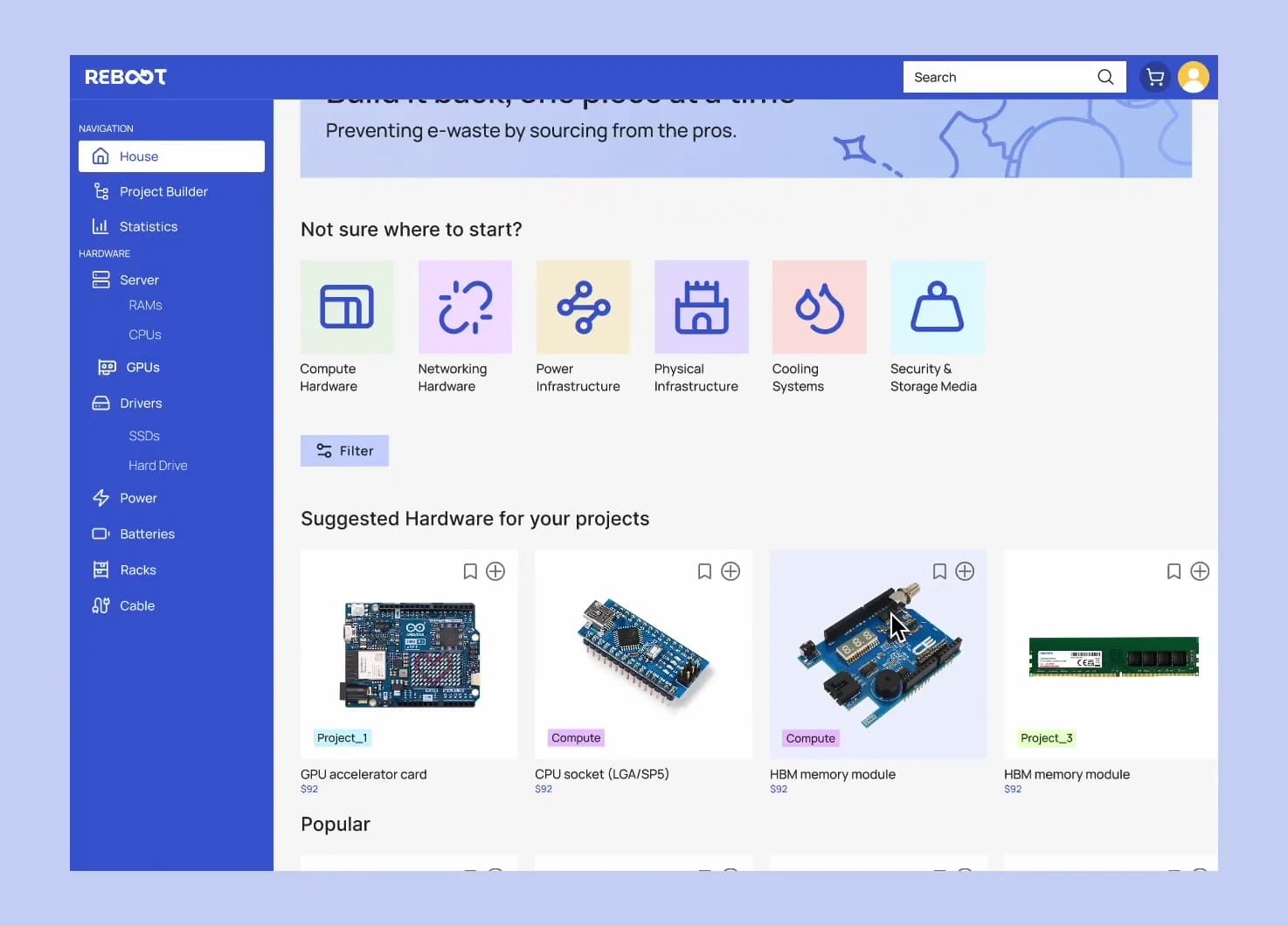
I organised the home page by what you want to build, not by specs.
38% wanted to build but didn't know where to start, so the home page opens with that question and answers it with use cases.
Use-case navigation
Compute, networking, power, cooling: hardware sorted by purpose instead of specs.
Progressive filtering
Narrow the list one choice at a time.
Recommendations in context
Suggested hardware, tagged by the project it belongs to.
Design decision
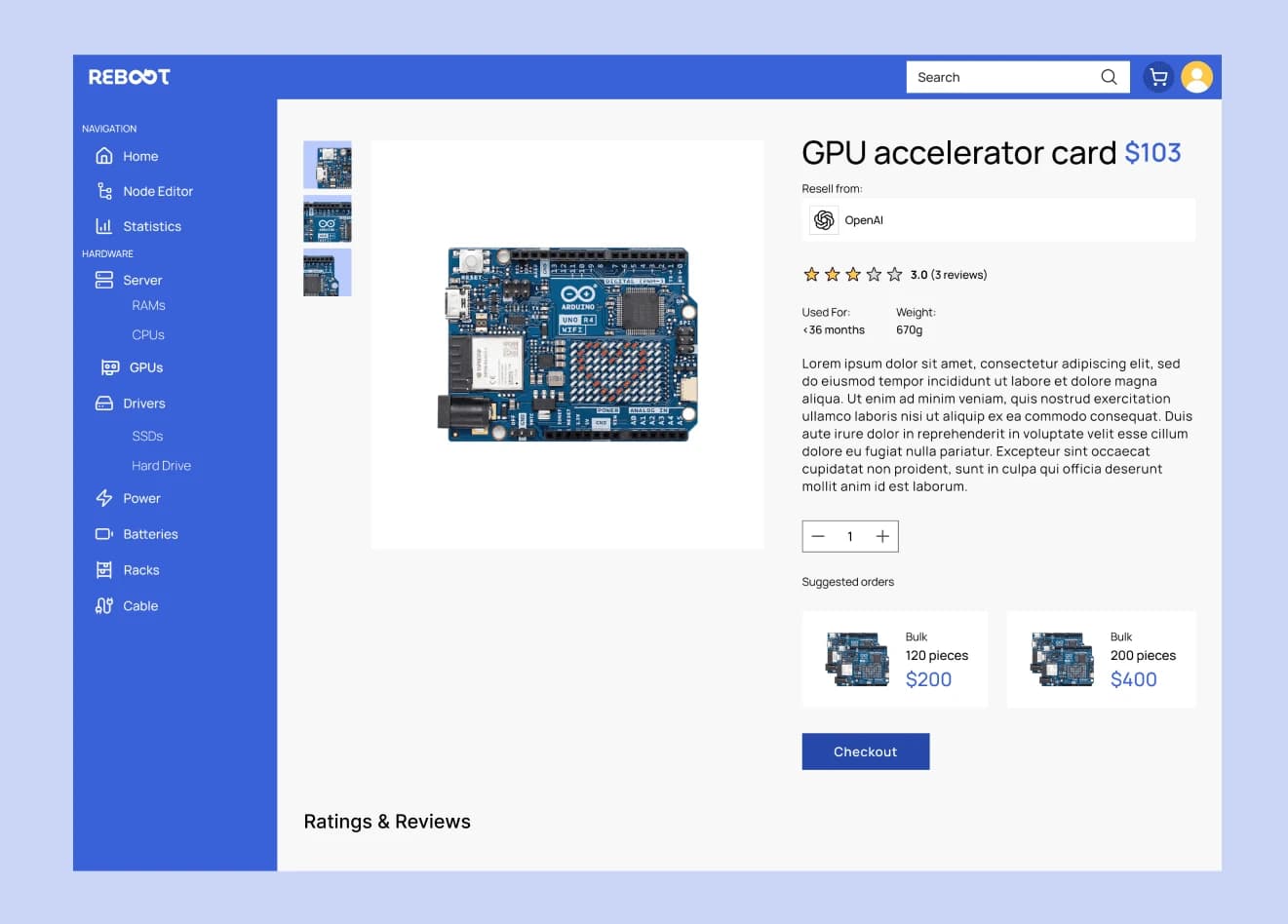
I linked every part to the data centre it came from, so a listing earns trust.
Each product shows its originating data centre, its usage and its condition, turning anonymous resale into traceable infrastructure. Bundles and bulk options sit right under it.
Solution
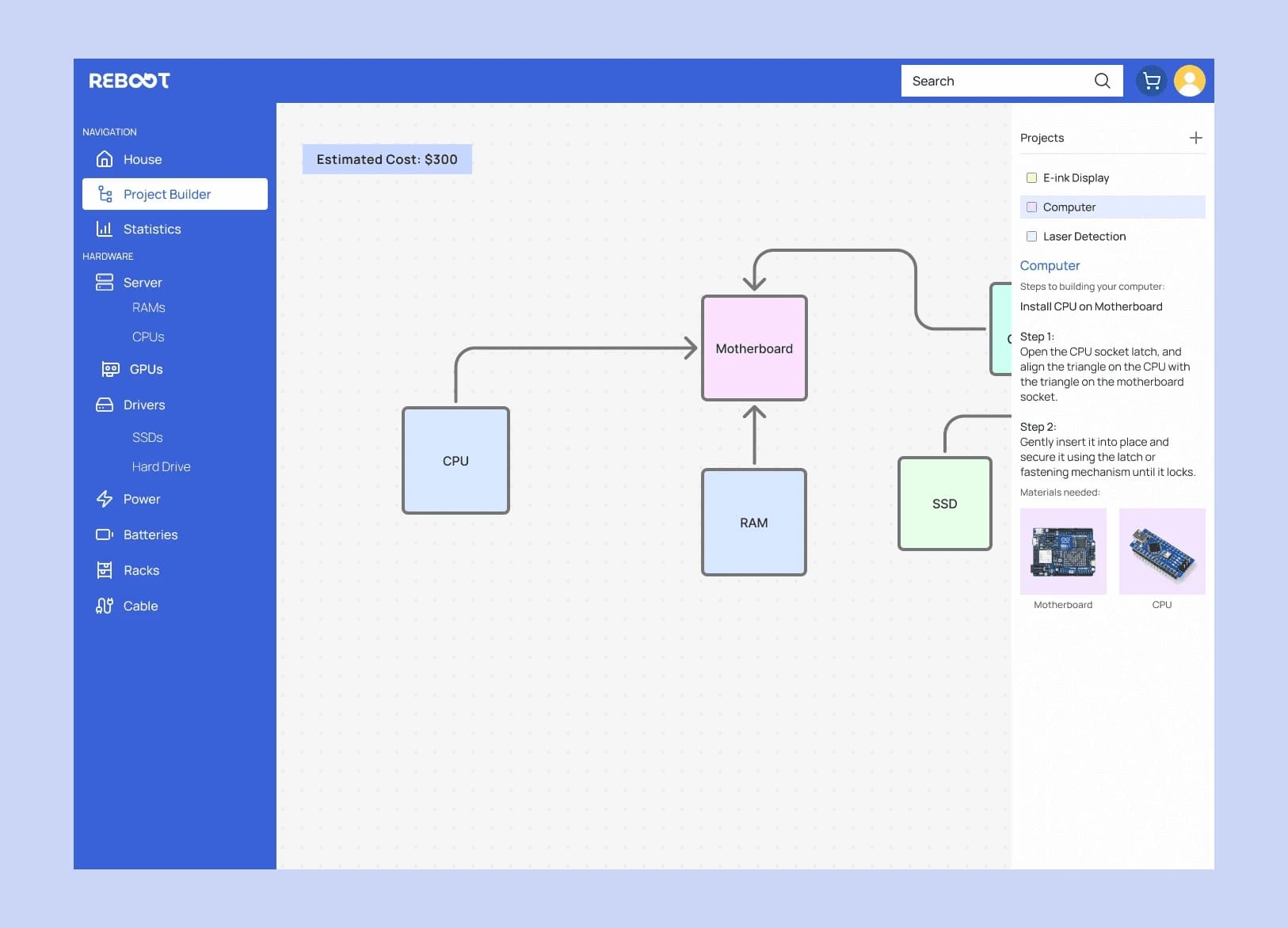
We designed a project builder that takes you from parts to a working build.
A node-based map shows how the components connect, with guided steps beside it and every part one click from the cart. Projects come in tiers, so beginners and experienced builders both have a path.
Design decision
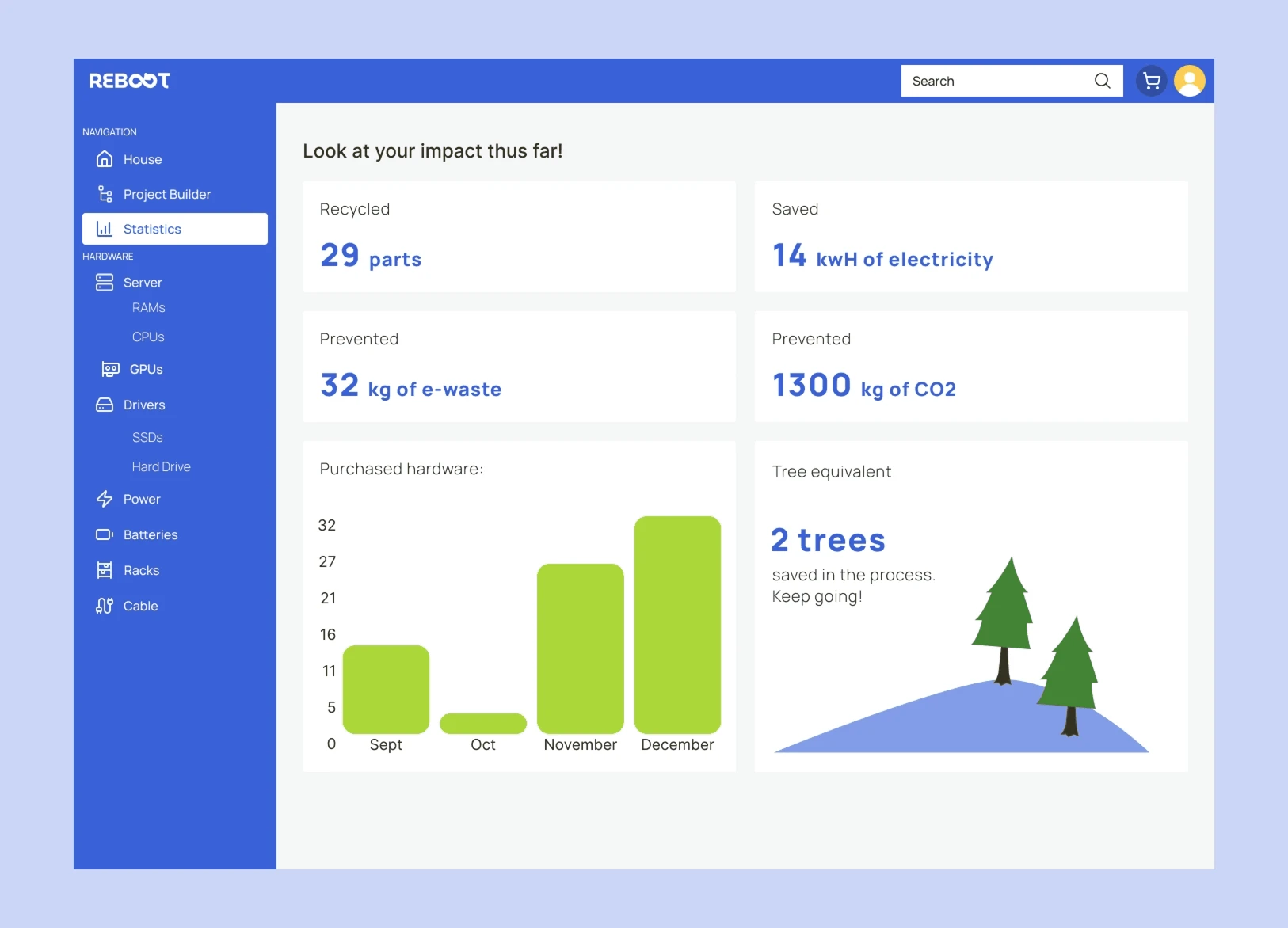
I made the environmental impact visible, so every build counts for something.
The statistics page shows the parts you recycled, the e-waste and CO2 you prevented and your progress over time, turning technical work into a contribution you can see.
What sets it apart
We changed three things marketplaces take for granted.
From specs to use cases
- Hardware is found by outcome and intent, so beginners never have to decode a spec sheet.
From buying to building
- Guided templates replace scattered tutorials, with clear steps for every skill level.
From waste to opportunity
- Surplus becomes a low-cost way into hardware, AI and systems building.
Outcome
We placed 3rd at the UofT UDesignathon.
Reboot
This is a snapshot of the process. Ask me for the full story.
say hi